
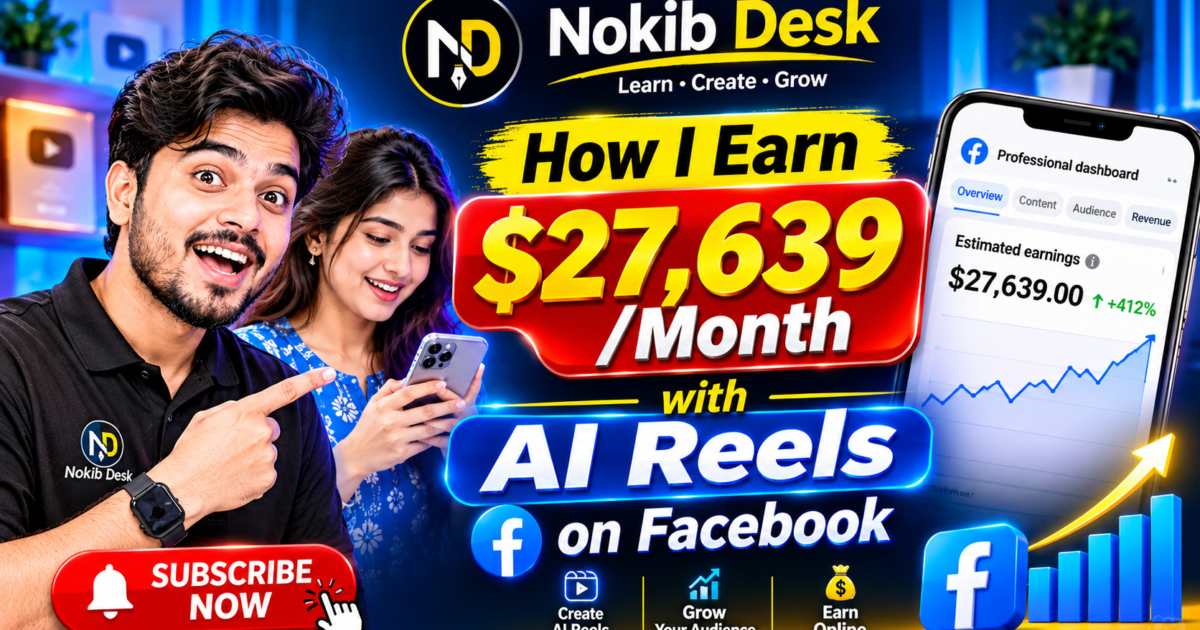
If you have ever wanted to earn from Facebook but felt intimidated by cameras, editing, or building an audience from scratch, the idea of using AI Reels may sound appealing. “How I Earn $27,639/Month with AI Reels on Facebook” explores a simple content approach: create short, attention-grabbing Reels around a specific niche, optimize a Facebook Page for discovery, and work toward Facebook Content Monetization.
This review looks at what the video teaches, who it may suit, and where beginners should be careful. The creator shares personal results from Facebook pages, including a newly monetized page that reportedly earned more than $600 shortly after monetization and another page that reportedly earned $16,000 in one month after a content-strategy change. These are the creator’s reported results, not a promise that every viewer will achieve the same outcome.
The method is not presented as a magical shortcut. The creator clearly says that anyone expecting effortless results may not enjoy the process. Instead, the video focuses on learning, testing, making mistakes, and improving over time. That makes it more realistic than many “easy money” videos, but it also means success depends on consistent effort, quality content, and an understanding of Facebook’s rules.

Why Nokib Desk Trust
Nokib Desk aims to give readers a clear, practical view of online opportunities without turning every product into a “get rich quick” promise. For this review, the focus is on what the video actually explains: using AI Reels, a focused Facebook Page, keyword research, and consistent publishing to pursue Facebook Content Monetization.
This review is based on the video title and transcript, not on assumptions about the creator’s broader business or results. The earnings figures mentioned in the video are treated as the creator’s personal reported results, not as a typical outcome or a guarantee for new creators. That distinction matters, especially because Facebook monetization depends on eligibility, policy compliance, content quality, and an invitation from Meta.[business.facebook][business.facebook]
The review also avoids presenting the creator’s income screenshots as proof that a beginner will earn the same amount. Facebook’s own guidance says creators need to meet eligibility requirements and follow monetization policies before they can earn from their content. A good review should separate a creator’s personal results from what a new user can reasonably expect.
What Is It?
“How I Earn $27,639/Month with AI Reels on Facebook” is a tutorial-style video about building a Facebook Reels page around a specific niche and using AI tools to create short videos. The creator uses fitness and workout content as the example, but explains that the broader process can be applied to other topics.
Rather than filming yourself, the method centers on creating an AI avatar, generating short Reels, and publishing them to a Facebook Page. The creator presents this as a way to produce content without appearing on camera or spending long hours editing.
The core idea is simple: choose a niche people care about, create Reels that match that interest, optimize the Page for discovery, and keep improving based on what performs. It is not presented as an automatic money machine; the creator specifically says that effort, testing, mistakes, and improvement are part of the process.
The video begins with an important point: a Facebook Page can be monetized but still earn very little if the content strategy is weak. The creator explains that one page was already monetized but made relatively small amounts before the content approach changed. After changing the strategy, the creator reports much higher earnings in later months.
That does not prove that every Page will see the same improvement. However, it does highlight an important lesson: monetization alone is not the goal. The real challenge is creating content that people actually want to watch, save, comment on, and share.
How It Works
The workflow begins with choosing a niche and researching related keywords. In the video, the creator uses fitness and workouts as an example, then looks for keywords with meaningful interest but lower or medium competition rather than choosing the broadest term available.
The creator recommends using a keyword research tool such as VidIQ. The idea is to avoid blindly choosing a popular keyword. Instead, you look for topics that have enough search interest to be worth creating content around, but are not so competitive that a new Page will struggle to stand out.
For example, the video explains that “fitness” is a huge topic, but it may be too broad for a new Page. A better approach is to find a more specific angle within the niche. The creator suggests comparing search demand, competition, and relevance before selecting a keyword.
Next, the creator sets up a Facebook Page using a memorable brand name combined with a relevant keyword. The Page name, category, and bio are designed to give Facebook a clearer understanding of the content topic. The video also mentions using professional mode on a personal profile as an alternative, although the creator prefers a Page.
After the Page is created, the process moves to content research. The creator looks for Reels with strong views and engagement on platforms such as TikTok or Instagram, then uses those videos as inspiration for new content. The video also describes an AI-assisted research method using a “deep agent” to find relevant video ideas.
The creator looks beyond view counts. Comments, saves, and the types of questions people ask can reveal what the audience wants next. In the fitness example, viewers ask about exercises and diet, which gives the creator ideas for future Reels.
Finally, the creator generates an AI avatar and creates short Reels—around 15 to 25 seconds in the example—using a reference video and a character sheet for consistency. The Reel is then uploaded with a keyword-focused file name, description, public audience setting, an AI-use label, and a strong cover image.
Features and What You Get
The video provides a practical, beginner-oriented workflow rather than a single software product. Here is what a viewer gets from the method:
- A niche-selection approach: Find a focused topic instead of competing directly in an overly broad category.
- Keyword-research guidance: Use tools such as VidIQ to explore search demand and competition before choosing a page direction.
- Facebook Page setup steps: Create a Page, choose relevant categories, write a keyword-aware bio, and add a profile photo and banner.
- AI avatar creation: Generate a consistent character for Reels, including a character sheet to keep the same look across videos.
- Content-idea research: Study high-view, high-engagement Reels and use comments to identify topics people want more of.
- AI Reel creation: Use an AI video tool to create short, vertical Reels without filming yourself.
- Upload optimization tips: Rename video files with relevant terms, write keyword-based descriptions, select strong covers, and make the post public.
- Monetization orientation: Learn that Facebook Content Monetization is invitation-based and that creators need to focus on quality content and policy compliance.
The video also mentions optional paid tools, including Abacus AI and VidIQ’s paid plan. These are presented as tools the creator uses, not mandatory purchases for every viewer.
One useful feature of the method is the focus on a consistent character. The creator explains that a character sheet helps keep the avatar recognizable across different videos. This can make a faceless Page feel more like a brand rather than a collection of unrelated clips.
The video also emphasizes the importance of the Reel cover. Since viewers often see the cover before deciding whether to watch, choosing a clear and attention-grabbing image can affect performance.
Who This Is For
This approach may suit beginners who want to build a faceless content page and are comfortable learning a repeatable process. It can also appeal to creators who prefer short-form video, AI tools, and a niche-based content strategy over traditional filming.
It may be a good fit if you:
- Want to create Facebook Reels without showing your face.
- Are willing to research a niche before creating a Page.
- Can publish consistently and improve based on results.
- Prefer using AI tools for avatars, video creation, and research.
- Understand that monetization requires patience, quality content, and compliance with Facebook’s rules.
It may not suit someone looking for a completely hands-off system or guaranteed income. The creator is clear that simply posting random videos is unlikely to produce strong results; the difference comes from strategy, testing, and understanding what an audience wants.
This method may also appeal to people who already have some interest in a niche, such as fitness, home workouts, beauty, pets, personal finance, or local tips. The video uses fitness as an example, but the underlying process—research, create, optimize, and improve—can be adapted to many topics.
However, beginners should not choose a niche only because it looks profitable. The creator stresses that the Page should attract people who genuinely care about the content. A relevant audience is more likely to engage, return for more videos, and help the Page grow over time.
Pros
- Beginner-friendly structure: The video walks through niche research, Page creation, content research, AI Reel creation, and uploading in a clear sequence.
- Faceless content option: The AI-avatar approach may appeal to people who do not want to appear on camera.
- Short-form format: The creator recommends short Reels, around 15 to 25 seconds, which can be easier to produce consistently than longer videos.
- Strategy over random posting: The method emphasizes audience interest, engagement signals, keyword relevance, and content quality.
- Practical optimization tips: File names, descriptions, covers, public visibility, and AI-use labeling are all covered.
- Realistic warning about effort: The creator explicitly says this is not a zero-effort shortcut and that testing and improvement are necessary.
- Focus on audience needs: The video encourages creators to study comments and identify topics people are actively asking about.
- Brand-building mindset: Instead of using random keywords, the creator suggests combining a memorable brand name with a relevant topic keyword.
Cons and Limitations
- Monetization is not automatic: Facebook Content Monetization is invite-only, so creating a Page and uploading Reels does not guarantee an invitation or earnings.
- Results are not typical or guaranteed: The income figures shared in the video are the creator’s reported results and should not be treated as what every beginner will earn.
- AI content requires care: Facebook’s monetization policies state that unoriginal or reproduced content without meaningful enhancement may not be monetizable. Creators need to add original value rather than simply copying trends.[business.facebook][business.facebook]
- Tool costs may apply: The video mentions paid options for VidIQ and Abacus AI, so beginners should budget carefully and avoid buying tools before they understand the workflow.
- Content research needs judgment: Looking at high-performing videos can provide ideas, but directly copying another creator’s video, character, or content could create originality and policy problems.
- Niche selection matters: A broad topic such as fitness may have a large audience, but it can also be highly competitive. The video itself recommends narrowing the focus.
- The income headline can create unrealistic expectations: The title highlights a large monthly figure, but the video itself explains that results depend on strategy, content quality, and consistent work.
Meta’s original-content guidance is especially important here. It says that third-party content posted without substantial changes may receive reduced distribution and can violate Meta’s terms and Partner Monetization Policies. In other words, using popular videos for inspiration is different from reposting them with minimal changes.[business.facebook]
Is It Worth It?
It can be worth exploring if you treat it as a content-building system rather than a fast-income promise. The video gives a clear starting framework: choose a focused niche, research what people want, create short AI Reels, optimize each upload, and keep improving.
The most important question is whether you are willing to create original, useful, engaging content consistently. AI can help with production, but it does not remove the need for good ideas, audience understanding, and compliance with Facebook’s monetization rules. Meta states that monetized content must meet additional standards beyond normal Community Standards, including requirements around originality and authentic audience engagement.[business.facebook]
For a beginner, the sensible approach is to start small, test a focused niche, learn from performance, and avoid spending heavily on tools before seeing whether the process fits your skills and schedule.
A practical way to begin is to choose one narrow topic, create a small batch of Reels, study which ones get the strongest engagement, and improve the next batch based on what you learn. This makes the process less overwhelming and gives you real feedback before investing too much time or money.
Final Verdict
“How I Earn $27,639/Month with AI Reels on Facebook” offers a useful introduction to building a niche Facebook Reels page with AI-created content. Its strongest point is the practical workflow: research the niche, set up the Page properly, study audience interest, create short Reels, and optimize uploads for discovery.
The video is most valuable for beginners who want a structured starting point and are willing to put in consistent effort. It is less suitable for anyone expecting automatic results, guaranteed monetization, or income without learning and testing.
Overall, this is a reasonable method to explore if you approach it patiently and ethically. Use AI as a production tool, create original content, follow Facebook’s policies, and judge results based on your own performance rather than the creator’s reported earnings.
The biggest takeaway is that Facebook Reels can be a real opportunity, but the opportunity comes from strategy—not from simply uploading videos and hoping for the best. If you are prepared to learn, test, and improve, the method may be worth trying.
FAQs
Do I need to show my face?
No. The video’s method uses an AI-generated avatar, so the creator does not need to appear on camera in the example workflow.
How long should the Reels be?
The creator recommends short videos, giving 15 to 25 seconds as an example. The exact length can vary, but the focus is on short, engaging Reels.
Can I monetize a Facebook Page immediately?
No. Facebook Content Monetization is currently invite-only, and creators must meet Facebook’s eligibility and monetization-policy requirements.
Do I need paid tools?
Not necessarily. The video mentions a free VidIQ plan, though it limits some keyword results. Abacus AI is presented as a paid tool the creator uses for AI research and video creation.
Can I copy viral videos from TikTok or Instagram?
No. The video uses popular Reels as research and inspiration, but directly copying videos could create originality and policy issues. Facebook says content that is unoriginal or reproduced without meaningful enhancement cannot be monetized.[business.facebook][business.facebook]
Is this a guaranteed way to make money?
No. The creator shares personal reported results, but the video does not offer a guarantee. Results depend on niche selection, content quality, consistency, audience response, and Facebook’s monetization eligibility.
What is the best niche for AI Reels?
The video uses fitness and workouts as an example, but it does not claim that fitness is the only profitable niche. The better approach is to choose a topic you can create useful, original content about consistently.
Should I use ads to grow a new Page?
The creator mentions using a small ad budget on some early videos, but also says this is not something every viewer should do. Ads may help with visibility, but they do not replace the need for quality content and a clear content strategy.

Leave a Reply